
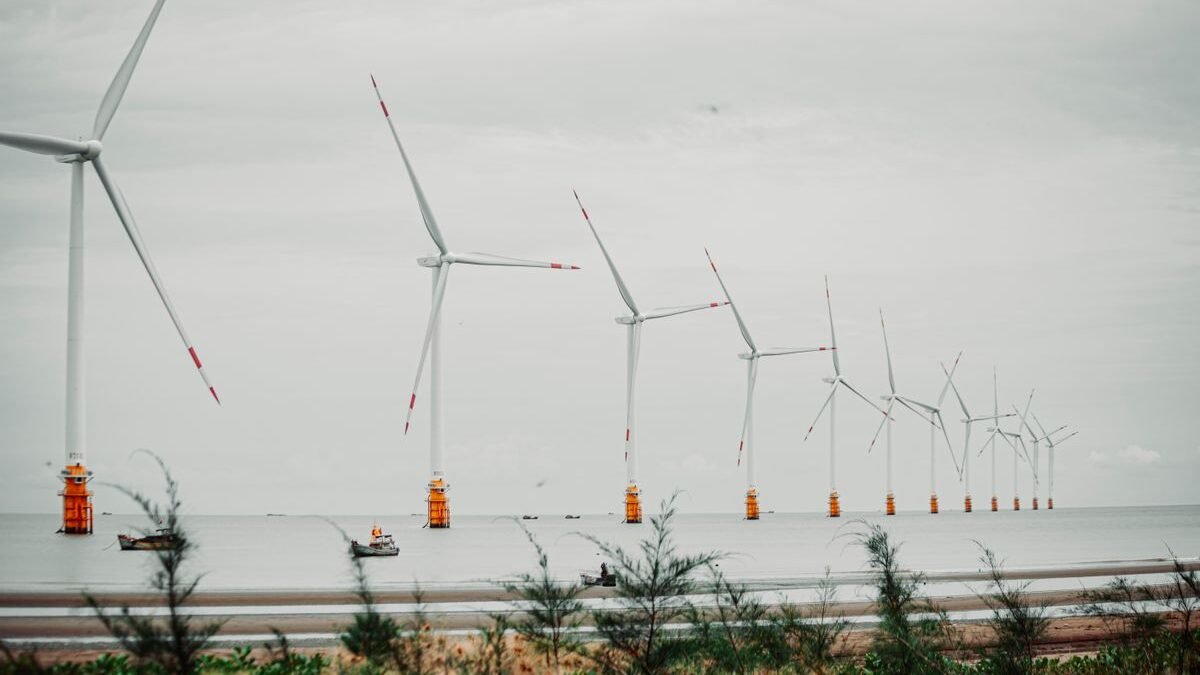
Construction crews working on a new offshore wind farm off Lithuania’s coast reached a major milestone this week, installing the project’s first turbine foundations — one of several offshore wind developments now underway across the Baltic Sea as the region positions itself as an increasingly important renewable energy hub for northern Europe.
- The Baltic Sea region’s combined offshore wind capacity is projected to exceed 4 gigawatts by 2030 across multiple national projects
- Lithuania’s first offshore wind farm is scheduled to begin partial operation in 2028
- Estonia and Latvia are jointly developing an offshore wind project in the Gulf of Riga
- The Baltic Sea’s relatively shallow waters make much of the region well-suited to fixed-foundation turbine installation
Why the Baltic Sea has become an offshore wind priority
Energy planners point to a combination of favourable wind conditions, comparatively shallow waters that simplify turbine installation, and growing EU pressure to diversify away from fossil fuel dependence as key drivers behind the wave of offshore wind investment now underway across the region. The push has intensified further amid the winter energy cost concerns documented in recent household energy coverage, with offshore wind increasingly framed as a long-term answer to the region’s exposure to volatile import-driven energy prices.
How the projects differ across the three countries
Lithuania’s project, furthest along of the three national efforts, is being developed by a consortium including both domestic and Nordic energy companies, with partial operation targeted for 2028. Estonia and Latvia have opted for a joint development approach in the Gulf of Riga, a collaboration officials describe as reflecting both shared technical resources and a desire to avoid duplicating grid connection infrastructure that could otherwise be built more efficiently once.
What industry experts say about the timeline
Māra Vītola, an energy sector analyst tracking Baltic offshore wind development, said the region’s projects remain broadly on schedule despite the sector’s well-documented global challenges with rising component costs and supply chain constraints. “What’s notable about the Baltic projects is that they’re being built with lessons already learned from the North Sea’s earlier, sometimes troubled offshore wind buildout. That should help avoid some of the cost overruns seen further west,” she said.
The grid question
Integrating large volumes of offshore wind power into the region’s electricity grid remains a significant technical and financial challenge, requiring substantial new transmission infrastructure and closer coordination with the Nordic grid following the region’s completed desynchronisation from the Russian and Belarusian power system. Regional grid operators say planning for this additional capacity is already underway, though the necessary infrastructure investment will take years to fully complete.
What this means for the region’s energy future
If current timelines hold, officials say the combined Baltic offshore wind capacity could meaningfully reduce the region’s reliance on imported energy and volatile wholesale pricing by the early 2030s, though most acknowledge the sector’s history of delays elsewhere in Europe warrants some caution about how firmly to treat current construction schedules as fixed. EU funding through the Connecting Europe Facility and dedicated renewable energy instruments has supported feasibility and early construction work across all three national projects, part of Brussels’ broader push to accelerate offshore wind deployment across EU coastal member states as part of the bloc’s climate targets.